
Land appreciation is one of the foundational drivers of wealth creation across global real estate markets. Unlike manufactured assets, consumer products, or physical structures that inevitably age and deteriorate, land possesses an intrinsic economic durability. While a residential house or commercial warehouse loses structural value over time due to wear, tear, and technological obsolescence, the underlying dirt remains permanent. In real estate terminology, buildings depreciate while the land beneath them appreciates. Understanding the exact economic mechanics that drive land value growth allows investors, developers, and wealth managers to locate, acquire, and hold raw acreage for maximum long-term capital appreciation.
At its core, land value growth rests on the immutable economic law of supply and demand. The physical supply of earth on the planet is fixed, whereas global population, urban concentration, economic output, and infrastructure networks continuously expand. As population centers grow outward, once-remote acreage transforms into vital real estate needed for housing, commerce, industry, and public infrastructure. However, land appreciation is not a uniform or passive process. It fluctuates based on spatial transition phases, local government decisions, economic productivity, and infrastructure investments. Evaluating how raw land gains value requires analyzing both macro-level economic forces and micro-level site characteristics.
The Fundamental Economic Drivers of Land Appreciation
Land appreciation occurs when the market value of a specific parcel increases over its original acquisition cost. Unlike income-producing assets that derive value from current cash flow, raw land value reflects the net present value of its future highest and best use.
The primary engine behind long-term value expansion is demographic growth paired with localized spatial scarcity. When a metropolitan area experiences sustained population growth, the demand for housing units, retail centers, logistics hubs, and medical facilities rises proportionally. Because central urban land is already fully developed and expensive, expansion naturally spills into peripheral surrounding areas. As the geographic boundary of active development approaches a parcel of land, its functional utility transitions from low-value uses like timber management or dryland farming toward high-value uses like suburban residential subdivisions or commercial centers. This functional shift yields massive jumps in land valuation.
Additionally, broad monetary forces play a significant role in land appreciation. In times of sustained economic inflation, real assets like land serve as reliable stores of value. As the purchasing power of paper currency declines and construction materials become more expensive, the intrinsic value of tangible natural resources, including land, trends upward. Land appreciation frequently outpaces general inflation metrics because expanding local economies generate localized demand spikes that far exceed national economic averages.
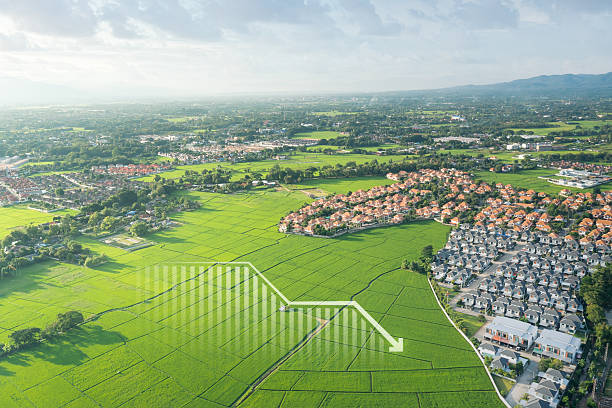
The Value Progression Cycle of Raw Land
Land does not appreciate at a flat, static rate over time. Instead, raw acreage moves through distinct value transition phases that reflect its proximity to active development, legal entitlement status, and physical infrastructure readiness.
The initial phase of the cycle is the long-term rural holding stage. During this period, the parcel sits well outside active municipal growth zones, utilized primarily for agriculture, forestry, or open space. Value growth during this phase is slow and steady, tracking general farmland appreciation rates and broad monetary inflation. The second phase begins when regional planning authorities announce major infrastructure projects nearby, such as new highway interchanges, water main extensions, or regional airport expansions. This infrastructure signal triggers speculative interest from land bankers and investors, accelerating the rate of land appreciation.
The third and most lucrative phase is the entitlement and development transition stage. During this window, municipal planning commissions rezone the parcel for higher-density uses, and developers secure engineering approvals. The land shifts from raw, wholesale acreage to finished, buildable inventory. Once physical infrastructure is installed and active construction begins on neighboring parcels, the land reaches its terminal value phase as prime buildable real estate.
Comparative Matrix of Land Value Transition Phases
Understanding how risk, valuation metrics, and annual growth rates change across land transition phases helps investors time their acquisitions and exits accurately. The table below details the core transition phases of raw land value growth:
| Value Transition Phase | Primary Land Use Status | Typical Annual Growth Rate | Investment Risk Profile | Primary Buyers in Phase |
| Stage 1: Remote Rural | Agricultural farming, timber, grazing | Low to moderate; 2% to 5% | Very low risk; low holding stress | Farmers, timber funds, long-term land bankers |
| Stage 2: Path of Growth | Speculative holding, interim leasing | Accelerated; 6% to 12% | Moderate risk; path dependent | Strategic land bankers, private equity funds |
| Stage 3: Entitlement & Rezoning | Permitted development inventory | High; 15% to 30%+ | Higher regulatory & legal risk | Speculative developers, master-plan builders |
| Stage 4: Active Construction | Finished building lots, active sites | Terminal market value peak | Low operational risk; market dependent | Homebuilders, commercial builders, end-users |
Tracking these distinct phases allows land investors to deploy capital at the exact moment when the risk-adjusted rate of appreciation is highest.
Infrastructure Expansion as a Value Catalyst
While demographic growth creates general baseline demand for land, infrastructure investment acts as the single most powerful catalyst for sudden, dramatic spikes in land appreciation. Raw land cannot be developed into modern residential neighborhoods or commercial hubs without access to essential public utilities and transportation networks.
Transportation infrastructure directly alters spatial accessibility, which is a primary determinant of land value. A parcel of land located twenty miles outside a city center may have minimal value if access relies on narrow, unpaved secondary roads. However, if the state department of transportation constructs a high-speed express highway with a dedicated interchange adjacent to the parcel, the transit time to the urban core drops from forty minutes to fifteen minutes. Overnight, the land becomes viable for commuter housing and regional distribution logistics, multiplying its market price per acre.
Similarly, utility infrastructure dictates development density limits. Land that relies entirely on private water wells and septic drain fields is strictly limited to low-density, multi-acre residential lots. The moment municipal water mains and sanitary sewer lines are extended to the property boundary, allowable density increases dramatically, allowing developers to build multiple housing units per acre. This exponential increase in buildable density directly translates into higher land value per square foot.
Zoning, Entitlements, and Legal Value Creation
Physical location and infrastructure availability set the baseline potential for land appreciation, but municipal zoning regulations determine its legal utility and financial ceiling. Zoning laws dictate what types of structures can be built, how tall they can be, how many units can be placed on a site, and what business activities can take place.
Securing favorable zoning reclassifications, a process known as land entitlement, represents one of the most effective ways to force forced appreciation on raw land. For example, a fifty-acre tract zoned for agricultural use with a limit of one single-family home per ten acres holds modest value. If an investor successfully navigates public hearings, traffic impact studies, and municipal planning reviews to rezone that same tract for medium-density residential housing allowing four units per acre, the site capacity jumps from five total homes to two hundred homes.
This legal transformation adds immense value to the property without moving a single cubic yard of dirt. Developers are willing to pay significant premiums for entitled land because the regulatory risk, public opposition, and municipal approval delays have already been cleared by the land owner.

Comparative Breakdown of Land Appreciation Drivers
Evaluating the primary factors that cause land to appreciate reveals distinct timelines, value impacts, and control levels for landowners. The table below outlines key land appreciation drivers and their characteristics:
| Appreciation Driver Category | Core Value Mechanism | Typical Impact Horizon | Landowner Level of Control |
| Demographic Population Sprawl | Broad housing & retail demand expansion | Long-term; 10 to 20 years | Completely passive; macro market driven |
| Major Highway & Transit Projects | Reduced commute times & increased access | Medium-term; 3 to 7 years | Passive; dependent on municipal budgets |
| Water & Sewer Line Extensions | Increased allowable building density per acre | Medium-term; 2 to 5 years | Partial control; through developer utility agreements |
| Municipal Rezoning & Entitlements | Legal approval for higher-density uses | Short to medium-term; 1 to 3 years | High control; driven by owner entitlement applications |
| Adjacent Commercial Developments | Clustered economic activity & amenities | Medium-term; 2 to 6 years | Passive; driven by neighboring anchor tenants |
By combining passive macro drivers with active legal interventions like rezoning, land investors can maximize total capital returns.
Micro-Site Factors That Boost or Limit Appreciation
Not all parcels located within a growth corridor appreciate at the same rate. Micro-level physical and geographical characteristics can cause two neighboring tracts of land to experience wildly different appreciation trajectories.
Topography and usable acreage play a major role in site valuation. Land that is flat to gently rolling is inexpensive to grade and service with utility pipes, making it highly attractive to developers. Conversely, parcels characterized by steep ravines, rocky outcroppings, or low-lying floodplains require millions of dollars in civil engineering and dirt movement, which directly reduces the amount a builder will pay for the raw dirt. Furthermore, the presence of federally protected wetlands or critical environmental habitats can restrict development to only a small fraction of the total parcel, capping potential appreciation.
Parcel shape, road frontage, and corner placement also dictate commercial land value. Parcels with extensive linear frontage along primary arterial roads offer high visibility and easy vehicular access, making them ideal for high-value retail or fast-food pad sites. In contrast, landlocked parcels that lack direct access to public thoroughfares appreciate far more slowly because securing access easements from neighboring property owners involves legal risk and expense.
Inflation Hedging and Macroeconomic Value Retention
Real estate has long been recognized as a prime hedge against currency devaluation and monetary inflation, but raw land occupies a unique position within this asset class. Buildings and structural improvements age, requiring continuous infusions of capital for repairs, renovations, and replacements to keep pace with rising price levels. Raw land requires no structural capital expenditures, making it a pure store of value.
During periods of high inflation, central banks expand money supplies, driving up the cost of commodities, labor, and consumer goods. Real assets with finite supplies naturally adjust upward in nominal price. As building materials like lumber, steel, and concrete become more expensive, the cost of constructing new buildings rises. This increase in total development costs pushes up the value of existing, strategically located land parcels that are ready for immediate site buildout.
Furthermore, global capital flows frequently seek safety in tangible, un-leveraged assets during times of geopolitical or financial market volatility. Land represents a physical, permanent asset that cannot go bankrupt, experience corporate fraud, or disappear overnight. This persistent demand from institutional investors and wealth-preservation funds creates a solid valuation floor under quality land holdings.
Step-by-Step Framework for Capturing Maximum Land Appreciation
To systematically target land parcels poised for above-average appreciation, investors should follow a structured evaluation framework that combines data analysis, site inspection, and strategic exit planning:
- Analyze Regional Demographic and Economic Trends: Identify metropolitan statistical areas experiencing consistent population growth, job creation, and corporate relocations.
- Study Municipal Comprehensive Master Plans: Review long-range land-use maps, transportation master plans, and capital improvement budgets to locate future growth corridors.
- Verify Existing and Future Infrastructure Connections: Confirm proximity to high-capacity thoroughfares, electrical substations, water treatment plants, and sanitary sewer trunks.
- Inspect Micro-Site Physical Characteristics: Conduct topographical analysis, soil percolation testing, and environmental wetland delineations to ensure maximum usable buildable area.
- Audit Title, Easements, and Legal Thoroughfare Access: Ensure the parcel possesses clean, unencumbered title ownership and recorded, legal access to public right-of-ways.
- Execute Value-Add Entitlements and Rezoning Applications: Apply for higher-density zoning classifications or master-plan approvals to lock in legal value expansion.
- Time Your Market Exit to Master Developers: Sell the property to active homebuilders or commercial developers once regional growth reaches the parcel boundary.
Following this structured step-by-step approach converts raw land speculation into a repeatable, data-backed investment strategy.
External Risks That Can Stifle Land Appreciation
While raw land offers exceptional long-term appreciation potential, investors must remain aware of external risks and regulatory shifts that can freeze land values or cause temporary price declines.
Economic recessions and rising interest rate environments represent immediate headwinds for land appreciation. When central banks raise interest rates to curb inflation, borrowing costs for homebuilders and commercial developers surge. High mortgage rates reduce consumer housing demand, prompting developers to pause land acquisitions and halt new construction projects. Because raw land produces no native cash flow to offset holding costs, land prices can stagnate or decline during prolonged real estate downturns.
Local political shifts and regulatory changes can also impair land appreciation. Municipalities facing public pushback against urban sprawl may pass anti-growth ordinances, implement strict building moratoriums, or dramatically increase developer impact fees. Downzoning initiatives, which reduce allowable building density on a parcel, can instantly wipe out a significant portion of a property market value. Additionally, environmental conservation expansions that declare surrounding areas as protected wildlife corridors or watershed protection zones can severely restrict future development rights.
Structuring the Optimal Holding Strategy for Land Growth
Capitalizing on land appreciation requires a disciplined holding strategy that balances annual carrying costs against projected value growth. Because land appreciation takes time to compound, maintaining financial liquidity during the holding period is essential.
Landowners should actively seek interim monetization options to eliminate out-of-pocket holding stress while waiting for surrounding growth to arrive. Executing agricultural crop leases, livestock grazing contracts, timber management programs, or solar farm ground leases generates recurring cash flow to pay annual property taxes and liability insurance premiums. Eliminating negative cash flow allows investors to hold land patiently through economic cycles without being forced to sell prematurely during market troughs.
When the time arrives to harvest accumulated appreciation, structuring the sale properly ensures maximum net profit retention. Utilizing 1031 tax-deferred exchanges allows land owners to roll the entire proceeds from an appreciated land sale into income-producing commercial real estate without triggering immediate capital gains taxes. Alternatively, offering seller financing to end buyers provides a steady stream of high-yield interest income while spreading capital gains tax liabilities over multiple tax years.
Conclusion
Land appreciates in value over time through a powerful combination of fixed supply, continuous population growth, expanding public infrastructure, and strategic legal entitlements. Unlike improvements that wear down and require ongoing maintenance capital, raw land represents a permanent asset whose value rises alongside the economic productivity and spatial expansion of surrounding communities. By identifying high-growth corridors, evaluating micro-site physical characteristics, securing higher-density zoning approvals, and utilizing interim leases to cover holding costs, investors can capture substantial long-term capital appreciation. When approached with data-driven research and financial patience, investing in appreciating land provides an enduring foundation for long-term wealth preservation and generational equity growth.
Frequently Asked Questions
Why does raw land appreciate while houses and buildings depreciate?
Raw land appreciates because its total physical supply is strictly fixed while population and economic demand grow over time. Buildings and houses depreciate because physical structures suffer from structural wear, material decay, and technological obsolescence, requiring constant capital reinvestment to maintain functional utility.
How does a highway extension affect surrounding land appreciation?
A highway extension drastically reduces transit times between remote land and urban employment centers. This increase in spatial accessibility transforms low-value agricultural acreage into prime buildable sites for commuter housing, retail centers, and logistics hubs, driving up land price per acre.
What is forced appreciation in raw land investing?
Forced appreciation occurs when a landowner actively takes steps to increase a property value rather than waiting for passive market growth. The most common method of forcing appreciation on raw land is securing municipal entitlements, such as rezoning the property for higher-density residential or commercial uses.
How do property tax exemptions help during the land appreciation period?
Property tax exemptions, such as agricultural or forestry current-use valuations, assess annual property taxes based on farm output or timber yield rather than full speculative development value. This reduces annual carrying costs by seventy to ninety percent, allowing landowners to hold land efficiently while appreciation accumulates.
Can land lose value during a real estate market downturn?
Yes, raw land can experience temporary value declines or extended illiquidity during broader economic recessions or high interest rate environments. When developer demand contracts and homebuilding slows, unimproved land prices adjust downward until economic growth and credit availability recover.